Photographs That Solved Investigations
Not every photograph that changed history did so because of how beautiful it was. Some did it because they were, literally, the evidence that settled a scientific debate, resolved a dispute over identity, or exposed a fraud that had gone undetected for decades. These are three real cases in which a specific photograph was the decisive evidence — no violent events or criminal cases here, just science, history, and the power of a camera placed exactly right at exactly the right moment.
The Photo That Confirmed Einstein Was Right (1919)
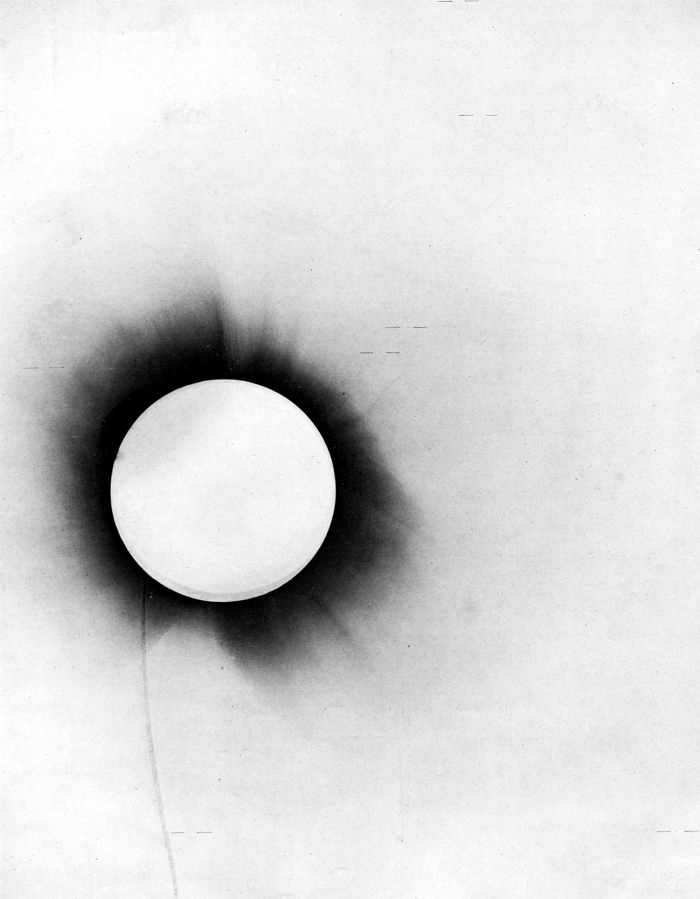
In 1915, Albert Einstein published his theory of general relativity, which predicted something that sounded like science fiction: the gravity of a massive object, like the Sun, should bend the path of light passing near it. It was a specific, measurable prediction — and it directly contradicted Newtonian physics, which had been the undisputed standard for more than 200 years. The problem was how to test it: the only way to see stars near the Sun without their light being completely overwhelmed by its glare was during a total solar eclipse.
British astronomer Arthur Eddington organized two expeditions — one to the island of Príncipe, off the coast of Africa, and another to Sobral, in Brazil — to photograph the total eclipse of May 29, 1919. They compared the photographed position of stars near the eclipsed Sun with their known position in the normal night sky. The difference matched, almost exactly, what Einstein had predicted. The news was published that November and turned Einstein, overnight, into the most famous scientific figure in the world — all settled by a photographic negative of a star slightly displaced from where it "should" have been.
The Photo That Invented Modern Forensic Identification (1879-1914)
Before Alphonse Bertillon, reliably identifying a repeat offender was nearly impossible: names were easily faked, and there was no reliable system to know whether the person arrested today was the same one already arrested under a different name years earlier. Bertillon, an employee of the Paris police, devised a system in 1879 — "judicial anthropometry" — that combined precise body measurements (skull length, foot length, middle finger length) with two standardized photographs: one from the front and one in profile, always with the same framing and the same distance. It is, quite literally, the direct origin of the "mugshot" as we know it today.
The system resolved thousands of false-identity cases across Europe over more than two decades, until it was gradually replaced by fingerprinting — a simpler, more reliable method, but one that would never have become standardized without Bertillon's earlier work proving that systematic, photographic identification, done properly, worked.

The Fraud That Took 41 Years to Solve (1912-1953)
In 1912, lawyer and amateur archaeologist Charles Dawson announced the discovery of a skull in Piltdown, England, that appeared to be the "missing link" between ape and human — with an almost human skull and an almost ape-like jaw. The British scientific community accepted it with near-immediate enthusiasm; it became a centerpiece of museums and textbooks for four decades. John Cooke's 1915 painting (the image above) immortalized the moment, showing eight of the country's most respected scientists examining the find, with a portrait of Darwin presiding over the scene.
It wasn't until 1953 that analysis using more advanced techniques — including fluorine dating, along with photographic and microscopic comparison of the tool marks left from filing and staining the bones — revealed the fraud: it was a medieval human skull combined with the jaw of an orangutan, artificially stained to look ancient, with the teeth hand-filed to simulate natural wear that had never actually occurred. The photographic and forensic investigation that exposed the deception became the reference case for how, even with the best scientific judgment available, a well-executed fraud can hold up for generations — until someone looks closely again.
What All Three Cases Have in Common
None of these three cases was resolved with a single quick glance — all of them required comparing, photograph against photograph, with precision and patience, something invisible at first sight. It's the same principle, at a very different scale, behind why compressing an image well matters: the details that really count are sometimes not the ones you notice right away, but the ones that hold up under close analysis.
If you want to keep your own photos at full quality so you can analyze them in detail later,compress them here, right in your browser, without losing what matters.